Grams to Cups
Convert any ingredient's weight into cups, tablespoons and teaspoons using its real density.
BakeScale turns grams, cups, ounces and teaspoons into exactly what your recipe needs — with real ingredient densities, oven temperature scales and pan math. No sign-up, no ads in your way, free forever for everyday bakers.
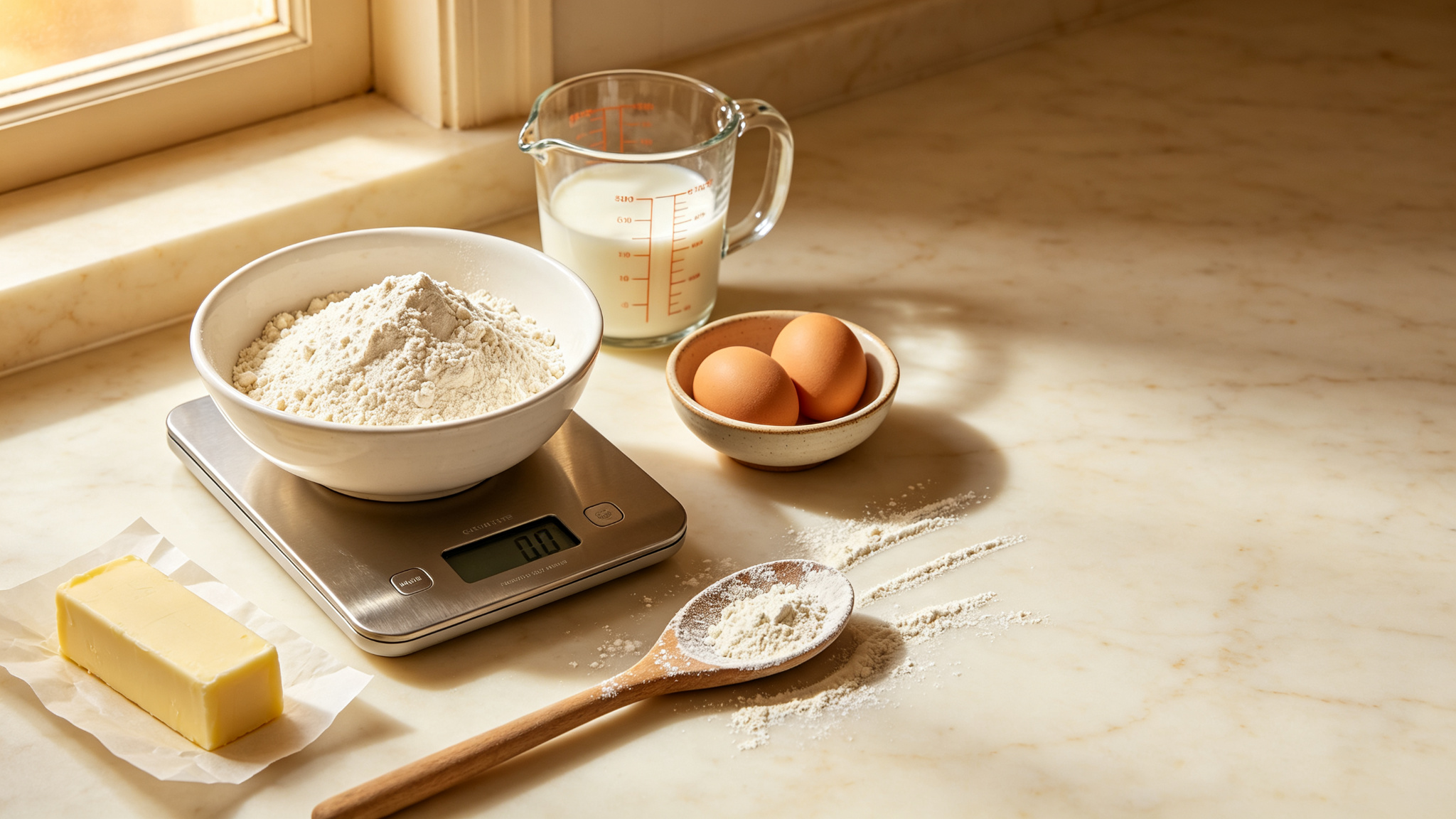
Seven focused tools, each tuned for a real baking task — from weighing flour to rescaling a 9-inch cake to 8 inches.
Convert any ingredient's weight into cups, tablespoons and teaspoons using its real density.
Turn cups, tablespoons and teaspoons back into exact grams — no more guessing with flour.
Convert Celsius, Fahrenheit, Gas Mark and fan-oven settings in one tap.
Millilitres, litres, cups, tablespoons, teaspoons and fluid ounces — all of them.
Grams, kilograms, ounces and pounds for any dry or liquid ingredient.
Rescale a recipe when you switch tins — round, square, loaf and more.
Multiply or divide whole ingredient lists in one go, with friendly fractions.
Favourite your go-to conversions, scale whole recipes, and later unlock custom densities and PDF export with PRO.
The conversions bakers search for every single day. Tap a row to jump straight to the tool.
| Conversion | Result | Method | |
|---|---|---|---|
| 250 g all-purpose flour | 2 cups | spoon & level | Convert |
| 200 g granulated sugar | 1 cup | spoon & level | Convert |
| 113 g butter | ½ cup (1 stick) | solid, softened | Convert |
| 1 cup brown sugar | 220 g | packed | Convert |
| 1 cup whole milk | 245 g | liquid | Convert |
| 500 g bread flour | 3.9 cups | spoon & level | Convert |
| 100 g cocoa powder | 1 cup | spoon & level | Convert |
| 1 cup honey | 340 g | liquid | Convert |
| 1 tbsp baking powder | 12 g | spoon & level | Convert |
| 350 °F oven | 180 °C · Gas 4 | conventional | Convert |
A cup of flour can weigh 110 g or 150 g depending on how you scoop it. Grams are exact — that is why professional bakeries measure by weight.
Set your scale, type a weight, and see every cup, tablespoon and ounce equivalent for 40+ common ingredients.
Every conversion uses the actual grams-per-cup density of that ingredient — flour is not sugar, and honey is not water.
Pin favourite conversions and articles. They wait for you in the Saved drawer on any device.
Practical, tested articles on measuring, converting and scaling — written for home bakers who want dependable results.
The complete guide to converting weights into volumes for baking — including the exact measuring methods that make the numbers work.
Read articleOne cup of flour can weigh 110 g or 150 g. Learn the spoon-and-level method, how to fix dough that's too dry, and when to switch to grams.
Read articleThe full map of oven scales, how fan ovens change your numbers, and why 350 °F is 180 °C but not always 175 °C.
Read articleQuick answers about how the conversions work and why numbers sometimes differ from other charts.
Density depends on how the flour is scooped. We use the spoon-and-level method with the widely referenced King Arthur Baking weights. Other charts may use the scoop method (heavier, 130–150 g) or sifted flour (lighter, ~110 g). Stick to one method and your results will be consistent.
A US legal cup is exactly 240 ml — the standard used on food labels and by most recipe charts. It differs slightly from the US customary cup (236.6 ml) used in older cookbooks. BakeScale uses 240 ml cups throughout, and so do most modern baking references.
For consistent results, yes. A cup of flour scooped straight from the bag can be 30% heavier than spoon-and-level flour. A $15 digital scale removes that entire source of error and makes cleanup easier — you can mix directly into the bowl on the scale.
Yes — every tool is free with unlimited use. We plan to add optional PRO features later (custom densities, batch recipe conversion and PDF export), but the core converters will remain free, and no account is ever required.
The densities come from published baking references such as King Arthur Baking and USDA data. Expect accuracy within a few percent when you measure the standard way. For critical results — especially large batches — verify with a scale.
All conversions happen in your browser — nothing is sent to a server. The only data we keep are your language choice, cookie consent and saved favourites, stored in your browser's local storage. Details are in our Privacy Policy.
Pick a converter, enter your numbers, and get results you can trust — in metric, US or both.
Start converting